



Water purifier filters are the core consumable part of all water purification systems. They determine water quality, user experience, and after-sales profit for B2B sellers. Many distributors focus only on low wholesale prices. They ignore filter lifespan, material safety, and regional adaptability. This causes high return rates and poor customer reviews.
This B2B guide helps importers and private label buyers source stable, cost-effective water purifier filters. It covers core filter types, water quality matching, certification standards, and bulk purchasing tips.
Understand Common Water Purifier Filter Types
Different filters serve different purification purposes. B2B buyers need to match filter combinations to local market demands.
PP cotton filters block large particles. They remove sediment, rust, and suspended solids. They act as the first-stage barrier to protect subsequent filter layers.
Ceramic filters filter tiny impurities. They feature dense micropore structures. They deliver stable fine filtration for daily household water.
Coconut shell activated carbon filters are popular for taste improvement. They effectively absorb residual chlorine, odor, discoloration, and organic pollutants. They greatly enhance drinking water flavor.
RO membrane filters achieve deep purification. They filter heavy metals, bacteria, and dissolved impurities. They are essential for high-purity water scenarios.
Multi-stage composite filters combine multiple materials. They complete full filtration in one cartridge. They are easy to replace and suitable for mass retail sales.
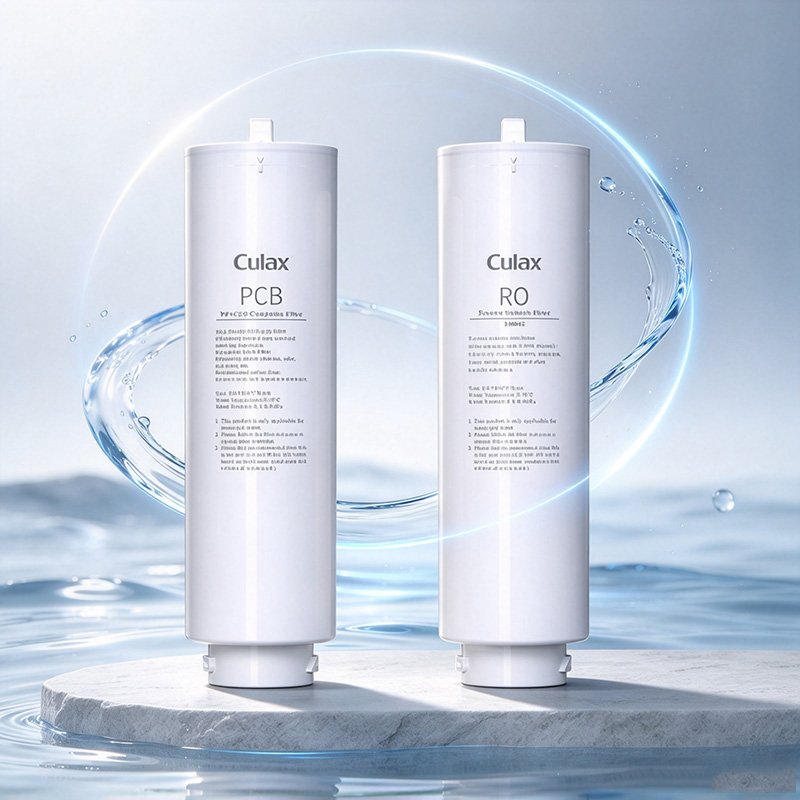
Calux Water Purifier Filter
Match Filter Performance With Local Water Quality
Before bulk sourcing, always analyze the water conditions of your target market. Water quality differs greatly across regions. Choosing mismatched filters leads to short service life and consumer complaints.
Areas with heavy sediment and rust need high-precision PP cotton and ceramic pre-filtration. These prevent early filter clogging.
Regions with heavy chlorine and strange odors require high-density activated carbon filters. They ensure better water taste.
Hard water areas with high mineral content need scale-resistant filter formulas and RO membrane solutions.
High bacteria-risk regions need filter sets compatible with UV sterilization systems. Combined purification delivers safer water.
Matching filters to local water quality reduces after-sales pressure. It also improves product reputation and repeat filter sales.
Key Quality Standards for Bulk Sourcing
Quality consistency is the top priority for B2B wholesale. Small quality differences will be amplified in large-scale sales.
First, check raw material safety. Food-grade materials are safer for water filters. Non-toxic and odor-free materials avoid secondary water pollution.
Second, verify filtration efficiency. Qualified filters have stable pollutant removal rates. They maintain consistent performance throughout their service cycle.
Third, confirm filter lifespan. High-quality filters support longer usage time. They lower end-user replacement frequency and increase customer satisfaction.
Fourth, check structural stability. Well-made cartridges avoid leakage, deformation, and blockage under normal water pressure.
Must-Have Certifications for Global Sales
Certifications determine whether your filters can enter mainstream overseas markets. They avoid customs detention and shelf removal risks.
Common authoritative certifications include CE and RoHS for European markets. NSF and WQA certifications add strong credibility for North American and global sales.
Formal manufacturers can provide complete test reports. These documents prove filter safety, purification performance, and material compliance. Certified filters are easier to promote and less risky for long-term wholesale business.
OEM & Private Label Customization Advantages
Water purifier filters are well-suited for private-label cooperation. Customization helps B2B sellers get rid of homogeneous price competition.
Reliable suppliers support custom logo printing, personalized packaging, and customized filter formulas. You can adjust filter density and material ratios for local water quality.
Flexible MOQ allows small-batch trial orders. Test market response before large-scale production. Custom filter products build unique brand advantages and improve profit margins.
Avoid Common B2B Sourcing Mistakes
Many new buyers fall into low-price traps. Ultra-cheap filters usually use inferior materials. They clog easily and have poor filtration performance. They cause large after-sales losses in the long run.
Do not ignore batch consistency. Stable factories maintain uniform quality in every production batch. Unstable quality will destroy your market reputation.
Do not overlook after-sales support. Professional suppliers provide stable stock supply and technical support for replacements. They support sustainable filter repeat sales.
Final Conclusion
Water purifier filters are the core profit point of the water treatment wholesale business. Successful B2B sourcing depends on water quality matching, stable quality, complete certifications, and reasonable customization.
Choosing reliable filter products reduces operational risks. It builds long-term brand trust and drives repeat orders. If you need stable bulk water purifier filter supplies or private label solutions, contact us for the latest wholesale price list and professional sourcing support.
FAQ
Q: Which water purifier filter sells best for wholesale?
A: Composite multi-stage filters and coconut shell carbon filters are the most popular. They fit most household water quality and meet mass market demands.
Q: Can I customize filter formulas for my local water quality?
A: Yes. Professional manufacturers support formula adjustment, logo, and packaging customization for brand-label orders.




 Deutschland
 United Kingdom