



PFAS in Drinking Water: What Water Purifier Manufacturers Need to Know
PFAS contamination has become a major issue in the drinking water industry. Consumers want safer drinking water. Meanwhile, regulators and water treatment companies continue to examine how these persistent chemicals affect water quality.
A study published in Cell Reports Sustainability on October 23, 2026, raises an important question about PFAS monitoring in the United States. The researchers found that common methods for handling test results below laboratory reporting limits may underestimate average PFAS concentrations.
For water purifier manufacturers, the message is clear: reliable testing, verified filtration performance, and transparent product claims matter more than ever.
1. What Does the New PFAS Study Tell Us?
Researchers, including Gehendra Kharel of Texas Christian University, analyzed US drinking water monitoring data covering 25 PFAS substances across 9,991 community water systems.
The dataset contained approximately 1.86 million individual test results. About 98% fell below laboratory minimum reporting limits.
However, a result below the reporting limit does not necessarily mean that PFAS is absent. Instead, it means the laboratory could not reliably report a precise concentration using the applicable method.
Why Reporting Limits Matter
When researchers treat these results as zero, they may underestimate average PFAS concentrations. To address this issue, the study used statistical models to estimate concentrations below the reporting limits.
The researchers found that treating these results as zero captured only 44% of the estimated average concentration across the 25 PFAS substances examined.
Nevertheless, this finding does not mean every US water supply contains twice the previously reported PFAS concentration. Instead, it shows how statistical methods can shape estimates of contamination levels.
For water treatment companies, the lesson is straightforward: accurate monitoring requires both reliable laboratory testing and careful data interpretation.
Read the original research in Cell Reports Sustainability.
2. “Not Detected” Does Not Always Mean Zero
Water quality reports use several terms to describe test results. These include “not detected,” “below the detection limit” and “below the reporting limit.”
Although these terms sound similar, they do not always mean the same thing.
Not detected: The test did not identify the substance above the applicable detection threshold.
Below the reporting limit: The concentration falls below the level at which the laboratory can reliably report a numerical result.
Zero concentration: The substance is completely absent. A result below the reporting limit does not prove this.
Therefore, manufacturers should review laboratory reports carefully before making product claims. Different PFAS compounds, analytical methods and laboratory capabilities can also produce different reporting limits.
More sensitive testing may reveal additional information about low concentrations. However, laboratories must still consider the target compounds, sample conditions and analytical quality controls.
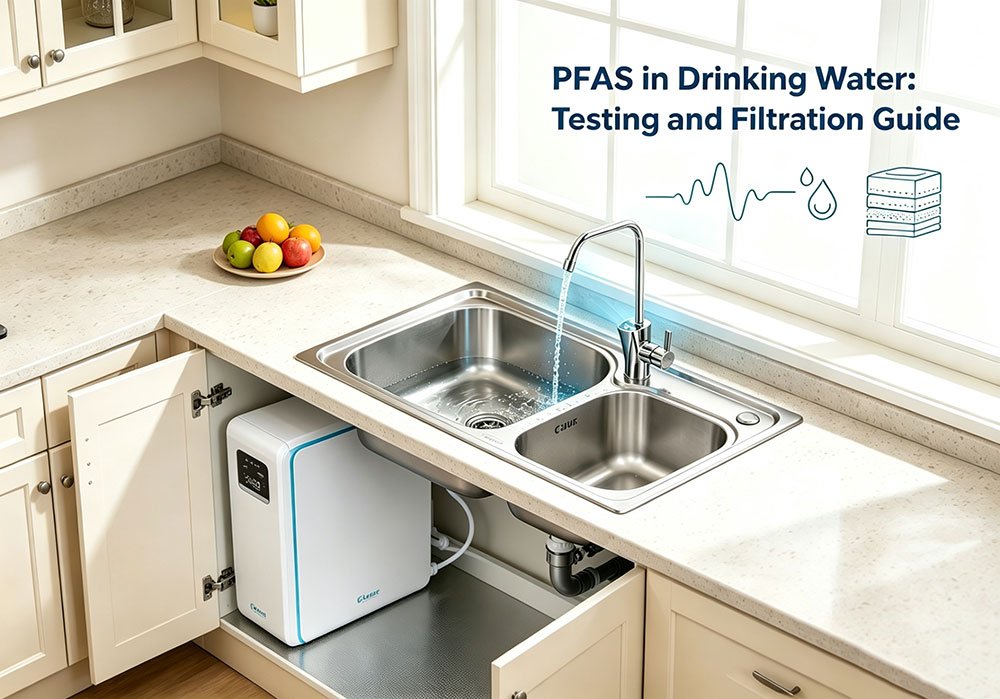
Calux-PFAS-water-filtration
3. Why PFAS Testing Matters for Water Purifier Manufacturers
PFAS refers to a large group of synthetic chemicals with different properties. Consequently, individual compounds may behave differently during water treatment.
Manufacturers should not assume that one filter delivers the same removal performance for every PFAS compound. Instead, they should build product claims around relevant test data.
Test Specific PFAS Compounds
General statements such as “removes harmful chemicals” offer little information about actual product performance.
Instead, manufacturers should identify the target contaminants and test the system under defined conditions. Depending on the intended application, the test panel may include PFOA and PFOS.
The selected test panel should match the product’s intended use and the claims that the company plans to make.
Define the Testing Conditions
Several factors can affect filtration performance. These include incoming water quality, contaminant concentration, water pressure, flow rate and filter condition.
Therefore, reliable testing should document the relevant conditions and use appropriate analytical methods. Manufacturers should not assume that results from one test apply to every water source or installation.
Evaluate Performance Throughout Filter Life
A filter may perform differently as it processes more water. Initial test results alone may not demonstrate performance throughout the cartridge’s intended service life.
For this reason, manufacturers should evaluate the filter under appropriate operating conditions and document its performance over the relevant period or capacity.
Clear replacement guidance also helps users maintain their systems. However, a filter-life indicator cannot independently prove that a cartridge continues to remove a specific contaminant effectively.
Make Claims That Testing Supports
Manufacturers should distinguish between tested contaminants, verified performance and capabilities that remain unproven.
This approach helps distributors and consumers understand what a product can do. More importantly, it reduces the risk of unsupported marketing claims.
4. Can Reverse Osmosis Remove PFAS?
Reverse osmosis (RO) plays an important role in household drinking water purification. Research has demonstrated that appropriately designed RO systems can reduce certain PFAS compounds.
However, the performance of an individual water purifier depends on its membrane, system design, operating conditions, target contaminants and maintenance.
Therefore, manufacturers must distinguish between the general capabilities of RO technology and the verified performance of a specific product.
What Should Buyers Check?
When evaluating an RO water purifier for PFAS reduction, buyers should consider several factors:
Target compounds: Which PFAS substances did the manufacturer test?
Removal performance: What reduction did the test demonstrate?
Test method: Which analytical method and laboratory procedures did the test use?
Operating conditions: What water quality, pressure and flow rate did the test involve?
Filter capacity: Did testing cover only initial performance or the intended service life?
Supporting evidence: Can the manufacturer provide a credible, traceable test report?
These questions provide a stronger basis for product evaluation than a general claim that an RO system removes all PFAS.
Furthermore, a test of an individual membrane does not automatically prove the performance of a complete water purifier. Manufacturers should support product-specific claims with evidence from the relevant system.
5. What Should Companies Entering the US Market Consider?
The United States remains an important market for household water purification. However, manufacturers must understand the applicable regulatory requirements and support their technical claims with suitable evidence.
The new study does not introduce a new certification requirement or change drinking water standards. Instead, it highlights how the interpretation of monitoring data can affect our understanding of PFAS concentrations.
Companies developing products for the US market should take the following steps.
Review PFAS-Related Product Claims
First, check whether claims identify specific PFAS compounds and reflect the available test evidence.
Avoid statements such as “removes all forever chemicals” unless the company can substantiate the full scope of that claim.
Match Testing to the Intended Application
Next, select test protocols that reflect the target contaminants, intended use and expected operating conditions.
Where appropriate, use qualified third-party laboratories or relevant certification programs. Always verify the applicable standard and the scope of any certification.
Maintain Clear Technical Documentation
Keep laboratory reports, test methods, operating conditions, and filter capacity records. These documents support product development, distributor training and technical reviews.
They also help teams respond to questions about performance and product suitability.
Monitor Regulatory Developments
Finally, track updates from the US Environmental Protection Agency (EPA) and other relevant authorities. PFAS requirements can evolve, so manufacturers should not rely solely on older regulatory summaries.
For official information, visit the EPA’s PFAS drinking water monitoring data page.
6. How Better Testing Builds Consumer Confidence
Today’s water purifier buyers need more than a list of filtration stages. They want to understand what a product can remove, how the manufacturer tested it and when they should replace the filter.
For manufacturers and OEM/ODM partners, this creates an opportunity to integrate testing and documentation into product development from the start.
A strong product strategy should focus on three areas.
Verified performance: Provide clear evidence to support contaminant reduction claims.
Practical product design: Make filter replacement straightforward and provide clear maintenance instructions.
Transparent communication: Explain tested capabilities and limitations in language customers can understand.
Together, these elements help manufacturers build trust with distributors, retailers and end users. They also support more informed purchasing decisions.
At Calux Filters, we recognize the importance of combining water purification technology with practical product design and clear technical information. For international buyers evaluating household water purifiers and OEM/ODM manufacturing options, testing documentation, cartridge availability and long-term support all deserve attention.
Ultimately, manufacturers should evaluate specific contaminant reduction claims against the available evidence for the relevant product.
Conclusion: Better Filtration Starts with Better Evidence
The October 2026 PFAS study highlights an important issue in drinking water monitoring. A result below a laboratory reporting limit does not automatically mean zero concentration.
For the water purification industry, the broader lesson is clear. Reliable filtration requires more than effective technology. It also depends on appropriate testing, careful data interpretation and transparent product claims.
As PFAS receives more attention, manufacturers that prioritize verified performance and accurate technical communication can better address the needs of distributors and consumers.
When choosing a household water purifier, ask three essential questions: Which contaminants has the manufacturer tested? Under what conditions did the system perform? And what evidence supports the claim?
These questions provide a practical starting point for evaluating filtration technology and making informed purchasing decisions.
Explore Calux Filters to learn more about our household water purification products and OEM/ODM capabilities.


 Deutschland
 United Kingdom